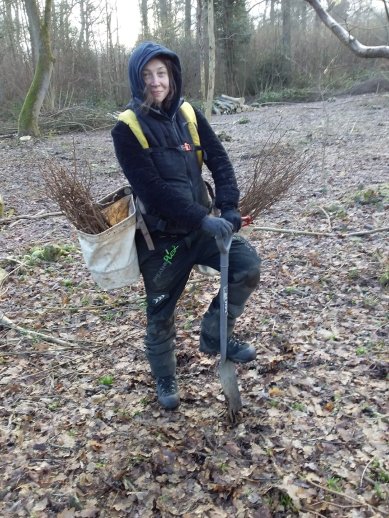
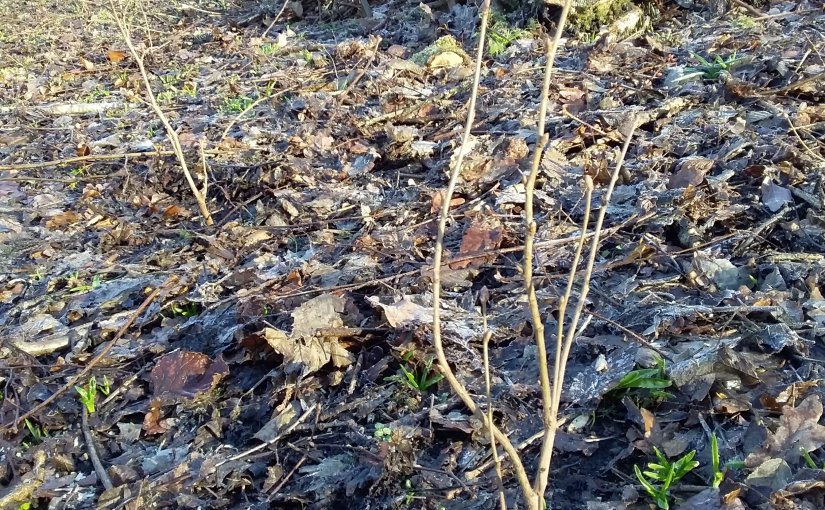
Now that the coppicing has finished, the layering is complete and the standards have been felled it is time to introduce the baby hazel whips to their new homes.
Iain plants whips, alongside layering branches from existing stools, to increase stock density. At the moment, in this particular coup, the density is about 3m on average between each tree. Iain would like to get this down to 1m. Having trees growing this close together will push the hazel to grow faster and straighter as each stem reaches for the light. It will also manage the light that reaches the woodland floor, as after 3 or 4 years, after the hazel has grown tall enough to block out the light again, the woodland floor will start to become clear of brambles and this preps the ground for the upcoming cut. Once the hazel is coppiced the bramble free floor will give the flowers the warmth and light they need to germinate, and it will also be easier for the coppice workers during the coppicing.
Some people disagree that planting is a good 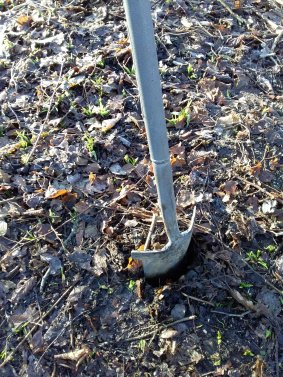 idea. This is mostly due to the unknown origin of the whip and the possibility that it won’t be acclimatised for the area. Although the whips come from the UK they may come from very different climates. Some of the trees in this years coup for example didn’t loose their leaves until the middle of December. This suggests that the whips came from a more northern climate than their southern cousins and were still waiting for a colder cue to loose their leaves. This was slightly problematic when making pea sticks and faggots as these products are often requested without leaves and so required some vigorous waggling to remove them.
Best practice is to use the stock already present in the coup to ensure that the trees will be acclimatised to the microclimate and are certain to flourish that soil. It also reduces the chance of new diseases being introduced to the area. However, when you are restoring coppice and need to increase the stock density filling the spaces with layering would require using more of the stems that could be potential products and they may not even root.
So whips provide a quick way to increase density and so far, apart from last year perhaps because of the hot weather, Iain has had a good amount of success with the them.
It is also a lovely task to do and if these babies are looked after well they will still be growing in that very patch of land in hundreds of years time.