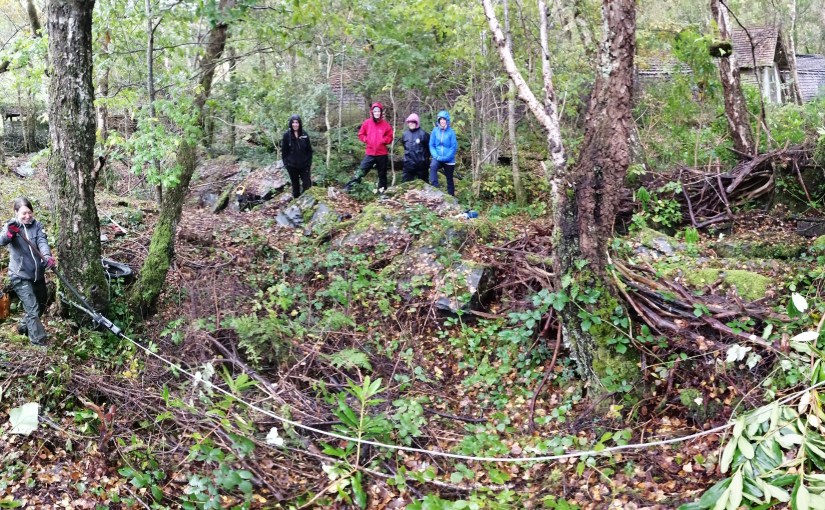
Getting People Back In The Woods

For many human beings the woods were our natural habitat.  Our ancestors spent thousands, if not millions, of years in this environment and so our senses are designed to cope with the ever changing sights, sounds, temperature and light that we experience in the woods.  Its no wonder we can go a little bit loopy when we’re stuck in the relatively static environment of the office or the school room that contrasts so starkly to our natural habitat.  Our senses don’t have enough to do and the energy is often redirected to mental rumination and stress.

Its not big news that a walk in the woods makes us feel better, but now we have the statistics and evidence to back this intuitive knowing and in Japan a practice called Forest Bathing has taken off and spread across the world.

The removal of clothes is not necessary to forest bathe, although what you do in your private woodland is up to you, instead it is an energetic bath, reducing neurochemicals such as cortisol, reducing heart rate and even effecting people with diabetes in a positive way.

So because of this a number of people are taking the baton and organising workshop and events under the banner of Social Forestry.
20191008_114907
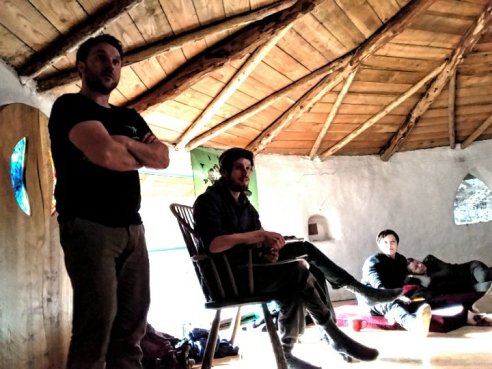
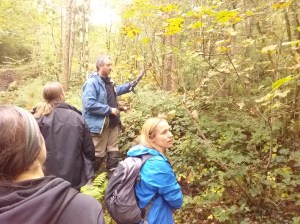
Rob teaching us about woodland management

Social Forestry is a fairly new term and is still deliciously being defined, but the gist of it is to get people back in the woods, not only for the wellbeing of the humans but for the wellbeing of the woodland habitat as well.

This latter part is important.  Forest schools and bush craft workshops tend to use the woodland as just an outdoor classroom space and the management of the woodland is sometimes not considered.  This can lead to woodlands being damaged.

For example,  if a group goes into woodland and it has a mix of conifers and young hardwoods such as oak, birch or cherry, the younger, smaller, hardwood poles will be easier for a group to clear.  However, in this case, the management plan might be to return the woodland to a mixed deciduous wood and so it would have been more beneficial to remove the larger, albeit more awkward conifers.

On a recent course at the Centre of Alternative Technology Julia Walling and Rob
20191009_154023
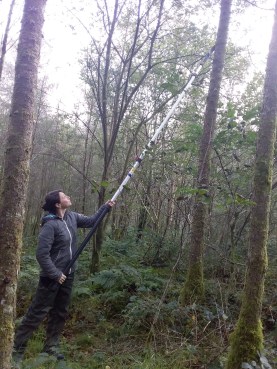
Using a pole saw to trim the bottom of conifers to allow more light into the woods.

Goodsell ran a Social Forestry course and took us through all the ways we can get people back into the woods, engaging with the environment in a meaningful way while benefiting the woodland itself.  Julia focused on the mindful aspects, inviting us to think about what makes us happy, how a woodland environment can fulfil these needs and showed us practical tasks to facilitate mindfulness.  Rob took us on a more practical journey through the kinds of tasks groups can do to help manage a woodland, such as scything, trimming branches and clearing bramble.

Of course there is an ultimate practical task that groups can do in the woods – coppicing!

Coppicing has the potential to be used by social forestry groups because it is a practice than can be done with hand tools and no previous experience.  It is highly beneficial to the biodiversity of the woodland and so you can enjoy a whole range of positive feelings from doing a good deed as well as spending time in a relaxing environment.

It is a sign perhaps of how chaotic and disconnected society has become from nature that we have to periodically flee to the woods to cope with it.  Forest bathing is a way to treat the symptom rather than the cause, but maybe if we’re all feeling little less stressed and a bit more centred we’ll be able to come up with better ideas on how to shape our society in the near future to one that suits our woodland natures better.



Its Official… I’m A Winner!

I am very pleased to announce that this very blog has won an award!

For the last three years Woodlands.co.uk have run a prestigious competition asking woody folk to enter their blogs, photos and any other woodland based activity they may be partaking, including this year the best woodland beard.  I’d completely forgotten that I’d entered it so was delighted when I received the email telling me that I was a winner! Thank you Woodlands.co.uk and I look forward to receiving my book and tool!

You can find a list of the other winners and catch all the woodland news in the woodland.co.uk Living Woods Magazine.


Turning Into A Basket Case

The truth must be told… My name is Suz and I am a basket addict.  It’s been two weeks since my last basket and I’m already having withdrawal symptoms.

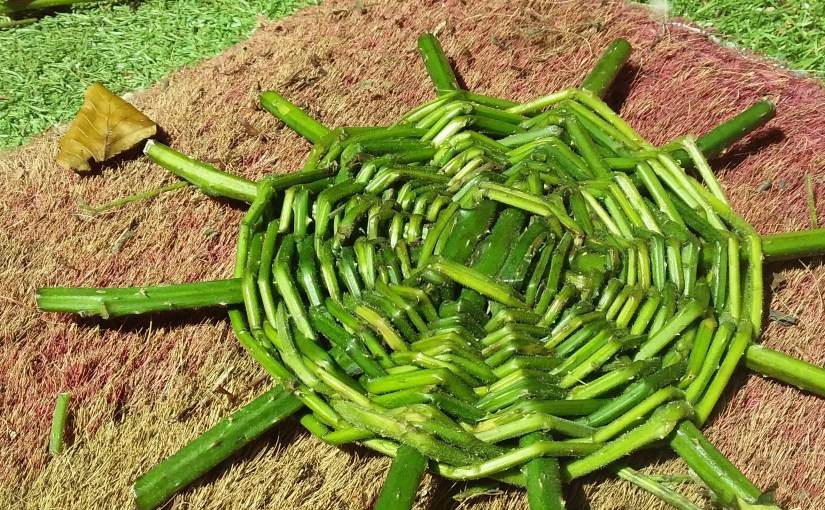
I made my first willow basket a few months ago at the Greenwood Centre with the lovely Rachel Evans of Wheatcroft Willow and the group agreed to start with a more advanced type of basket, an oval shopping basket rather than the easier round basket. At first I didn’t understand the pattern at all.  I felt a swell of frustration rise up but persisted and under Rachels’ fine tutelage she got me past the first hurdle and I left the weekend with a beautiful shopping basket.


It is a sign of an excellent teacher to be able to guide eight or nine people in making a full blown oval based basket, especially as some of us were first timers, and then have them go away with something decent.  I know this because, since the course, I have had a go at teaching and although I understand the technique and can make a reasonable basket shaped object myself, teaching others to do the same takes some skill.

My first attempt was to run a bramble basket making workshop at the farm where I often visit.  Everyone was eager to learn this skill, and cut back the ever encroaching brambles, and with only four others it was fairly easy to get the basic techniques across.  However, my second attempt, at the crafty Treehouse Festival, things became a little more tricky.  Firstly, we were using pieces of willow from a tree that hadn’t been pollarded in a while so all the lengths were trimmed from this years growth meaning they were short and branchy.  Secondly, everyone wanted to make a basket!  I kept the group down to seven but that was still a tough amount of people to work with, especially as I was keen to make my own basket as well.

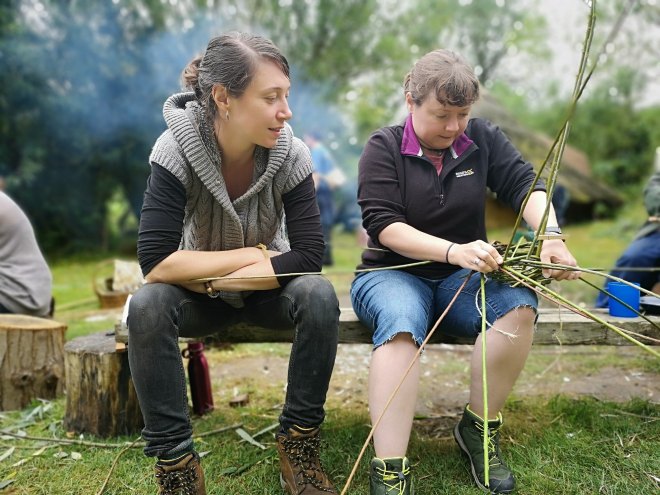
me and kay

The art to teaching is to keep calm.  It requires projecting confidence onto your students and giving them the patience that they need to give themselves as they learn a new skill.  It requires empathy as one remembers ones own frustrations and keeping them focused on moving forward.  It requires the right language and turning that language into visual instructions.  No one will understand what you mean if you say ‘now this bit goes into this bit’  – as I soon discovered.  It also required a never ending enthusiasm to answer the same questions over and over again.  But with all that said, I loved every second.  Some people even went away with something that looked very much like a basket.  Both of these opportunities were invaluable and were great steps towards doing something I really love to do – to teach.

More Than Just The Bluebells

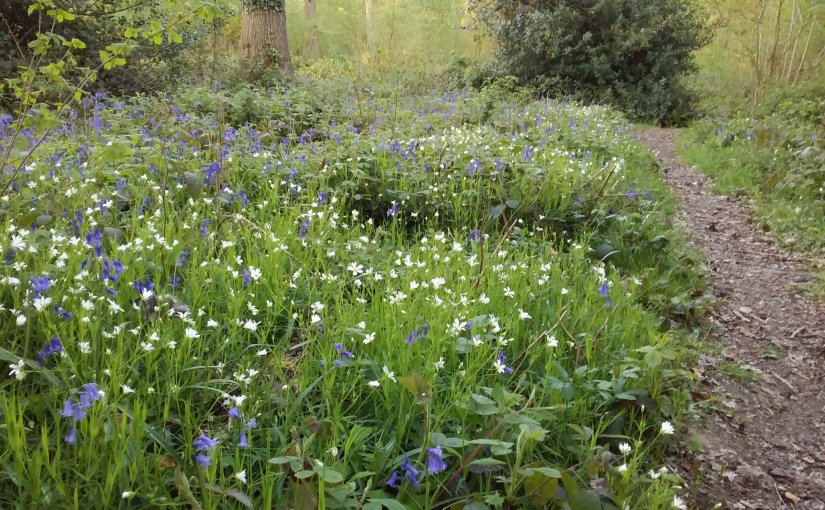
At this time of year woodland lovers marvel at the beauty of bluebells woods. Suddenly the usual green hue is carpetted in a luminous blue and sweet aroma. People tread carefully, if at all, so as to not trample all over these very welcomed inhabitants.

But its not just the bluebells that inhabit our woodlands at this time of year. When given some light through woodland management, such as coppicing, many other species of flower adorn the woodland floor. As I took a stroll through last years coup I was astonished to see the variety of woodland flowers and it really hit home how important woodland management is for the biodiversty of this ecosystem.

I have no idea what most of these flowers are so please enlightenment if you see any you recognise!

Making a Box with Mr Cox

As soon as I saw Sebastian Cox’s website I knew I had to meet him.  Here was a person who was doing exactly what I’d like to see happen with coppiced material – turning them into modern, high-end furniture.

Traditional, rustic furniture certainly has its place, and its audience, but there is also a wider potential audience that enjoy a more contemporary look and who are keen to support british makers and British woodlands.

20190310_111529
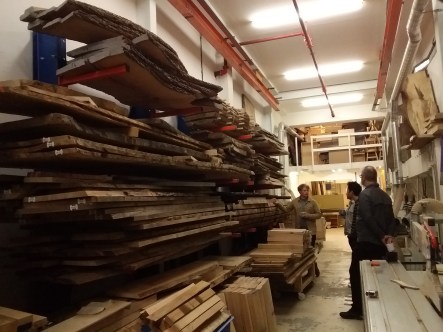
Sebastian’s collection of British sawn timber

Sebastian began his journey in 2010, noticing the disconnect between the customer and the supplier of the material.  A visit to a timber yard brought home the odd experience of passing acres and acres of woodland only to find all the timber in the yard was imported.  Our woodlands are severely under-managed in this country – up to 50% – yet we continue to import wood.

How we change this practice is a question that both myself and Sebastian share.  Our relationship with food, and where that comes from, has changed dramatically over the last decade or so.  How do we do the same for wood?

Sebastian is answering this question through design, and educates his customer base through the products he offers.  Rather than using whatever the customer requests instead he offers and informs the customer of what wood is available this year and designs something beautiful out of that.  It means that the customer still gets what they want but they use up surplus timber supplies such as beech and ash.

As for the box.  I had a good go with some American Walnut that was grown in this country.  I loved the beautiful purple hues in the timber along with a dark brown waney edge.  Dove tails are a lovely joint to work with – as long as you get them the right way around.  Thank goodness for mallets and ample supplies of wax to fill in the gaps!

It was great to see the master at work and get lots of useful tips.  I definitely recommend it as a good day out.

(A full interview with Sebastian Cox will be published in the Small Woods Magazine shortly!)

Growing The Woodland Branch of the LWA

This weekend I was invited to attend the Landworkers Alliance woodland branch manifesto meeting.  There are many people who work in woodlands and this offshoot hopes to reflect and promote the needs of those workers.

The LWA Woodland Branch’s manifesto is being developed to be presented to governing bodies and they wanted to know what issues us woodland folk have.

Some of the issued raised included earning a living wage, suitable housing, lack of contracts and stability, lack of education and awareness of management practices and awareness british woodland products.

One of the key issues for me is the lack of awareness of woodland workers, the products that they create and the importance of supporting these businesses.  For example, a lot of our firewood and charcoal is imported.  This is diabolical when we have so much unmanaged woodland in our own country, and a fair few people willing to manage them, if only they could afford it.

wp-1552318513514659758563.jpg
Members of the LWA woodland branch meaning business

Most woodland workers could afford this if they were allowed to live in low impact dwelling in the woods they managed.  Sometimes this is possible but usually the set up is precarious and threatened with the specter of the planning department.  The lack of contracts and agreements can also leave people in limbo when it comes to their rights to live on and manage the woodland.  People are often given short notice to move on, which can be a blow after you’ve spent so much time, energy and resources into bringing a woodland back to life.

Most woodlands workers could also afford this if they were supported by the public and the government.  Currently there are no subsidies available for small woodland workers and so unless one is happy to live in a yurt, which to be fair a lot of us are, you’re going to struggle to make an income.  Yet woodland work is just as important as the food industry, and even has the added bonus of being of benefit to the environment.  Woodlands have been managed for thousands of years by humans, and for millions of years by the movement and browsing of large roaming mammals.  This is a vital practice for the continuation of many woodland species yet 50% of our woodlands are still unmanaged.


In the past workers could survive on the low income/high lifestyle benefits of woodland work.  But with the increasing, and unrealistic, rental and house prices, the demand for cheap imports and the lack of public education on woodland management it becomes a difficult enviroment to flourish in.  The LWA Woodland Branch plan on changing that.


New homes for Baby Trees

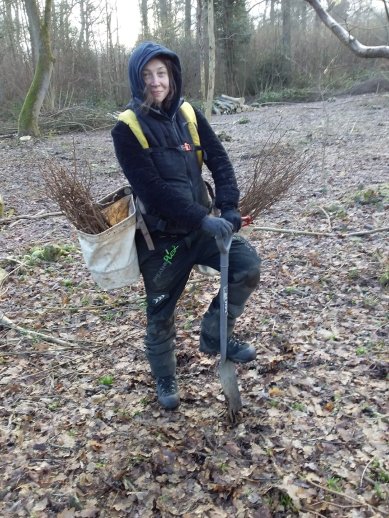
Now that the coppicing has finished, the layering is complete and the standards have been felled it is time to introduce the baby hazel whips to their new homes.

Iain plants whips, alongside layering branches from existing stools, to increase stock density.  At the moment, in this particular coup, the density is about 3m on average between each tree.  Iain would like to get this down to 1m.  Having trees growing this close together will push the hazel to grow faster and straighter as each stem reaches for the light.  It will also manage the light that reaches the woodland floor, as after 3 or 4 years, after the hazel has grown tall enough to block out the light again, the woodland floor will start to become clear of brambles and this preps the ground for the upcoming cut.  Once the hazel is coppiced the bramble free floor will give the flowers the warmth and light they need to germinate, and it will also be easier for the coppice workers during the coppicing.

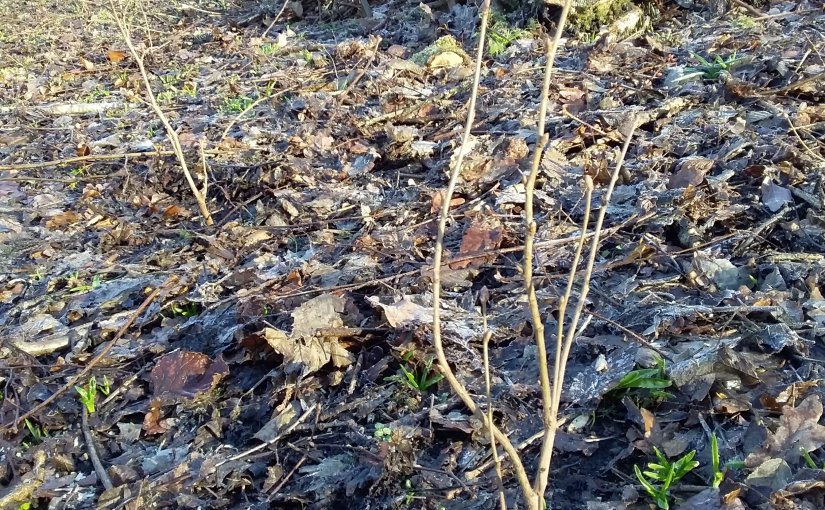
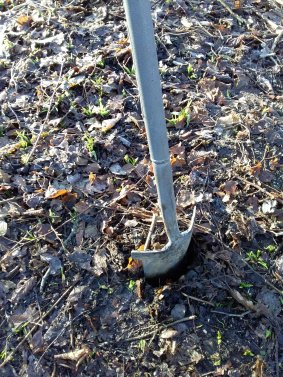
Some people disagree that planting is a good 20190211_0904251571531758.jpgidea.  This is mostly due to the unknown origin of the whip and the possibility that it won’t be acclimatised for the area.  Although the whips come from the UK they may come from very different climates.  Some of the trees in this years coup for example didn’t loose their leaves until the middle of December.  This suggests that the whips came from a more northern climate than their southern cousins and were still waiting for a colder cue to loose their leaves.  This was slightly problematic when making pea sticks and faggots as these products are often requested without leaves and so required some vigorous waggling to remove them.
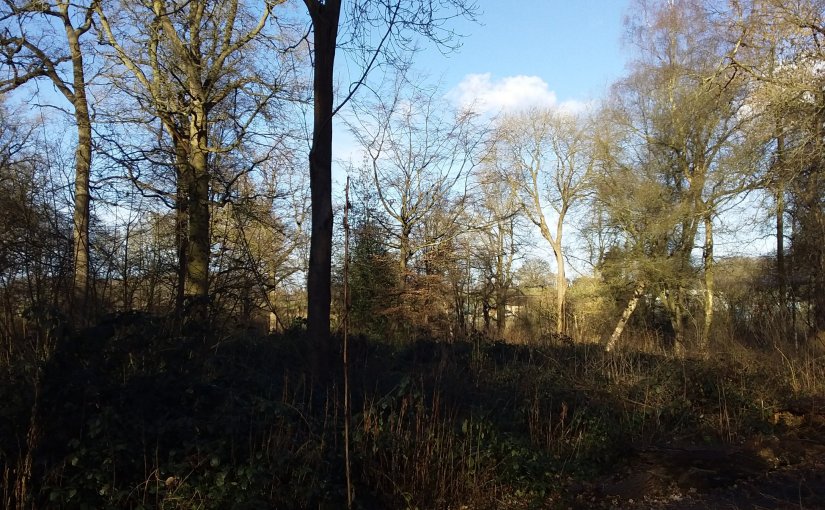
Best practice is to use the stock already present in the coup to ensure that the trees will be acclimatised to the microclimate and are certain to flourish that soil.  It also reduces the chance of new diseases being introduced to the area.  However, when you are restoring coppice and need to increase the stock density filling the spaces with layering would require using more of the stems that could be potential products and they may not even root.

So whips provide a quick way to increase density and so far, apart from last year perhaps because of the hot weather, Iain has had a good amount of success with the them.

It is also a lovely task to do and if these babies are looked after well they will still be growing in that very patch of land in hundreds of years time.

20190211_0855261613609448.jpg


For The Birds


Today we’ve been taking out some of the ‘medium’ standards in the coup. I put quotation marks around medium because they look bloody huge to me!

Bringing these ‘medium’ trees down will allow more light onto the woodland floor, a floor that is already showing signs of Bluebells.

Bluebells!

It can seem like a harsh practice to the casual onlooker. Surely trees are sacred and need to be protected? It’s true, they are and they do. Which is why its great when weaker trees with signs a disease and rot are chosen. The elderly birch that fell today hardly had any stump left on the ground, only being held up my it’s buttresses, and this is obviously dangerous. However, it can just sometimes be the tree that will let in the most light into the coup.

As well as the flowers, the other clear benefit (no pun intended) of a Coppice woodland, compared to an unmanaged dark and murky woods, is the proliferation of small birds.

lovely bit of light

Furzefield is covered in tiny birds. Everytime we fell a tree or disturb some leaf litter were followed by a handful of robins checking out to see what the hell we’ve been doing to their territory and is there anything new to eat. Gangs of bluetits mosey on by and various other tiny hoppers, which I can’t identify, also fill the branches. The whole woodland is alive with birdsong that, ok you can’t really hear while the chainsaw is going, but as soon as we swap the saw for the billhook it’s clear that this is a very popular place indeed.

Fact Corner:

For commercial aka simple Coppice the ideal is to have no standards at all in a coup. This will produce the finest Coppice material. But usually, especially in this country, Coppice with standards is the norm. In this case the ideal is 10-20% canopy cover and goes up to 20-30% when you want to leave enough for the wildlife. Having a variety of ages and sizes of stands is also good to consider so that you have a constant flow of younger trees replacing the older ones. Standing wood, when the tree dies and you leave it up, makes great homes for all sorts of things and doesn’t stop the light from reaching the Coppice.

Faggots!


Happy New year everybody! I hope you are all well rested and ready for the coppicing season.

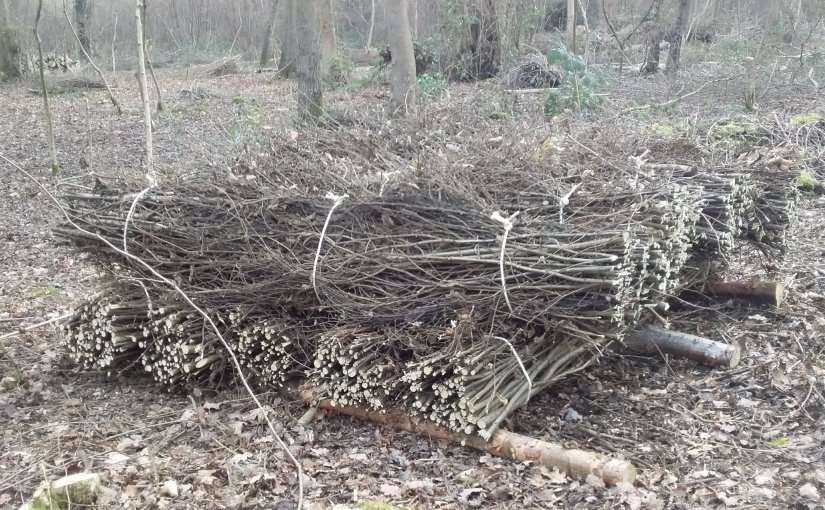
Over the last month or so I have been helping Iain Loasby with the Coppice he manages in Potters Bar. All the hazel came down before Christmas and now we are gathering together the different products to sell.

This year Iain has a order for faggots. Watford district council have ordered floating berms to place alongside the bank to reduce bank erosion and faggots are ideal for this.

Faggots can be used for a few different things. Traditionally they were used as kindling for baker ovens to keep the bread oven at a high temperature. They can be used as material for dead hedging and most importantly, making forts.

20190114_1127301897626277.jpgBut one of the best things about faggots is that they use up the parts of the tree that would otherwise be left as brash. Each 20kg faggots can be sold for £8 Each, which is not bad for a bunch of twigs.
 

To prepare a faggot Iain has made a bench that allows him to bundle and trim the faggots. He based his on an Alan Water’s design and it works a treat.

So there you go. Faggots are great and don’t let anyone else tell you otherwise.

Casually Inventing a New Gate Hurdle

wp-15429977541471909718796.jpg

Last Friday I had the honour of working with Martin Wise who has been a gate hurdle maker for many years in the South Oxfordshire area.

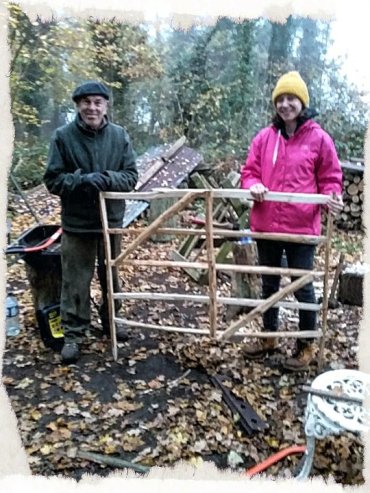
Gate hurdles, unlike hurdle hurdles, are made from cleaving a log, in this case sweet chestnut into two ‘heads’ and five ‘rails’ along with three supports, one down the middle and traditionally one on each side.  But not on this particular Friday.

wp-15429978871031112989044.jpg

Oh no.  Martin and myself invented the ‘Oxfordshire/Tottenham’ style with the supporting struts sporting a parallel design.  As all the rails were connected to the top or bottom rail Martin couldn’t see a reason not to try it out and it seemed to work ok!

A comment from a Facebook group wondered how long the gate would hold its strength but I guess we’ll have to wait and find out!  Keep peeled for an update in the next few months.