
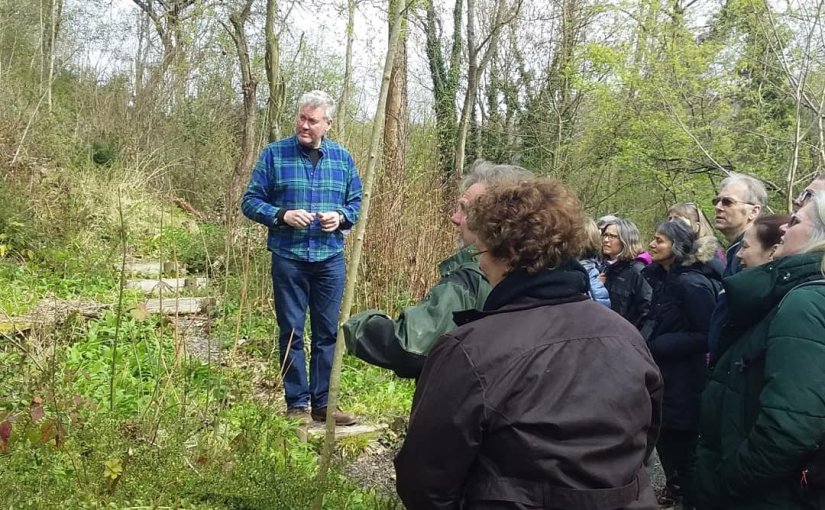
I had a chance this weekend to really get my teeth into woodland management. After spending a lot of time in the woods over the winter and taking part in coppicing, felling trees and watching tree surgeons top and lop, I was excited to be able to correlate some of my practical experience with the management side of things.
The workshop was led by Jim Waterson, who has managing woodlands for many years and now teaches other newbies like me.
Of course, my main interest is the coppice aspect of woodland management, but it was also interesting to learn about what is called High Forest – the trees that you don’t coppice.
Making a woodland management plan involves quite a few considerations. These are short-term and long-term considerations, often thinking beyond your own lifetime. A plan also needs to be clear and easy to understand so that who ever inherits the plan can understand what you were on about and what your vision for the woodland was.
A big consideration at this time is climate change/chaos. We are in a period of unpredictable weather that could adversely effect our native woodland species. With the prediction of rising temperatures and water levels we need to be thinking about what tree species are going to thrive best in this environment. Some species of french oak might fair better in hotter climes and species such as lime and sycamore might be more hardy in hotter weather. (Ideally, we’d be holding the industries responsible for climate chaos accountable and not needing to apply any damage control – but there you go.)
Pests and diseases are also on the up. This is due mostly to imports but is compounded by climate chaos which stresses the trees, leaving them more susceptible to attacks.
Management of a woodland comes with a fair amount of responsibility, especially if one has public paths. However, even if you don’t have the public wandering through your woods you are still liable for taking measures to ensure that the woodland is well-managed and that any dangerous branch or tree is dealt with. Public liability insurance is a good idea.
When it comes to the legal side of things most small woodland owners won’t need a felling licence. One is allowed to fell up to 5 cubic metres per quarter and if you’ve just bought a 6 acre woodland.co.uk property you could probably cut your entire woodland down in a year with that (please don’t). Some types of felling are also exempt and coppicing trees under 150mm comes under this, which is handy. But make sure you check with your local tree officer before undertaking any work. Any trees cut down that are in a designated area and require a license or have a Tree Preservation Order could leave you in court.
If you are interested in taking one of these courses then get in touch with the Small Woods Association or do a quick search online and look out for Jim Waterson.


Then again your management plan can be binned as coppicing ”comes to an end”
LikeLike