Reading The Logs

Did you know that logs can predict your future?

That’s right. A log can accurately predict the likelihood of you swearing under your breath when it refuses to split.
wp-1536857598020..jpg
A beeping beep

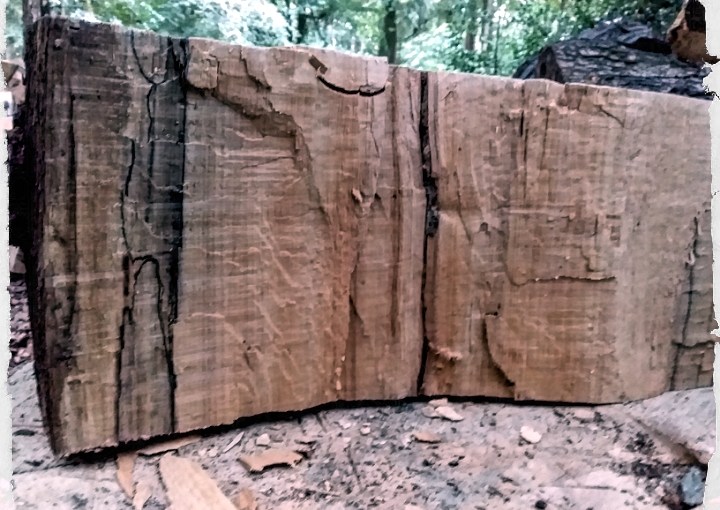
Trying to split a 50 – 60cm diameter piece of tree can be quite a challenge. Especially if it was a gnarly bit, a point where the tree split or is still too damp and keeps absorbing the maul. The first three or four foot of the tree are also notoriously tougher. So sometimes its not just a case of whacking it as hard as you can – although that helps – but just like in palmistry you need to learn how to read a log.

Every single part of the tree is different and so each new round piece is a different challenge. My mentor Mark suggested going for the heartwood first and getting a split in that. Then it seemed that heading for the edges helped the split to shoot through the log.

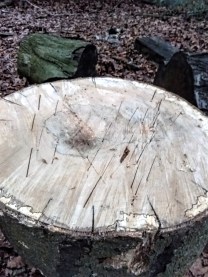
But when the basics don’t work you need to have a closer look at the details of the particular piece of round wood in front of you. For example, each piece of trunk has a small crack in it’s centre. Logically you might think, like I did, that if I followed that crack it was be an easy task. But actually what I found was that it split better if I went perpendicular to that natural crack. The cracks around the side of the ring are not always useful either. Some times they can indicate a point of weakness but, as Mark put it, sometimes they are irrelevant.
wp-1536857427976..jpg
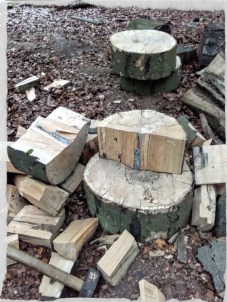
A friendlier bit of tree trunk

The main thing to look out for is signs of branches. These bits are going to be very knotty and its best to chip around them rather than attempting to hack them into smaller pieces.

Turning a piece of trunk upside down can also help. Sometimes one side is more forgiving than another. When you’ve got a really big piece then it might be a case of chipping off one side then going around the ring as if you’re slicing up a cake. Once you’ve split the piece of trunk in half you can have a really good look at the way the tree has grown and chose the spot where the rings are straightest and will easily split in half.

There’s nothing quite like hearing that certain cracking noise to predict a little internal fist pump after you’ve spent five minutes trying to split a bit of tree trunk.
Splitting Logs

“Before enlightenment, chop wood, carry water. After enlightenment, chop wood, carry water.”

Zen Proverb


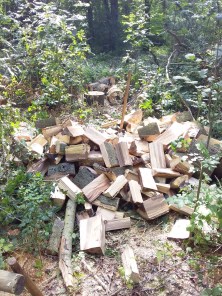
Today in Coppice Land I have spent a lovely day in the woods chopping wood.  Firewood is a good income for coppicers and my Mentor, Mark, was lucky enough to know someone with a group of dead beech trees that needed taking down. Mark has kindly obliged and now has a stack of logs to send of to a local garden centre.

20180904_123339.jpg
pile of logs

The key thing I found when splitting logs, or also sometimes called cleaving, is that you need to use your legs. Unfortunately I didn’t actually do this – and after four hours of log splitting my back is killing me! Its a classic mistake to use your back when doing any strenuous work but next time I’ll be using my legs more – even if it means I have to stand in a funny crouching position all day.  Its worth it!

Otherwise it was a very satisfying job. Perhaps, I mused while I chopped, it’s because this job is probably written into my very DNA. For thousands of years we’ve been doing this kind of work and my body seemed to have a natural intuitive reflex towards the task… although thinking a bit more about it, and feeling how my back feels, perhaps not. But I have to say, there is something romantic and wholesome about splitting logs.

The most zen moment of the whole day was when I realised that the splitting became easier when I stopped trying to do the work, meaning, when I let the maul (the heavy

20180904_113253-1.jpg
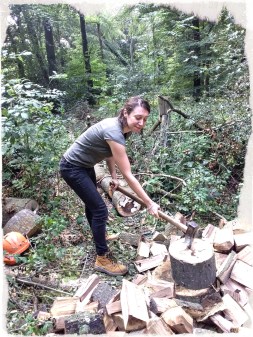
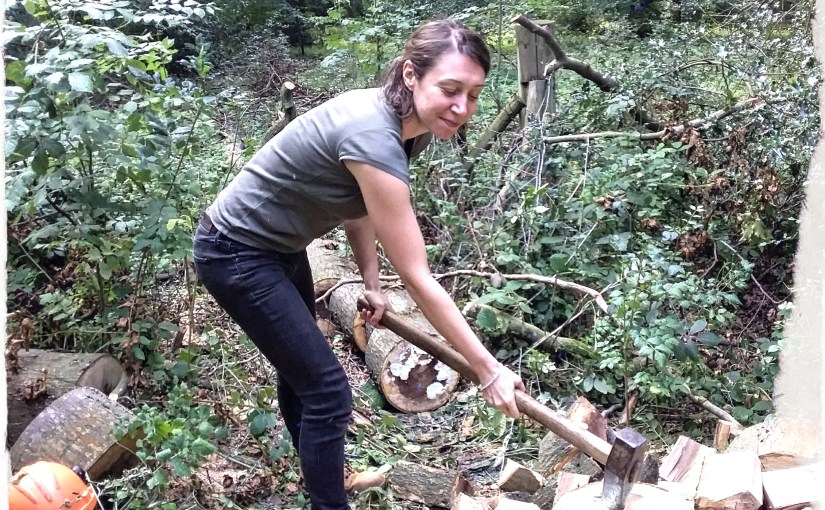
how NOT to hold a maul if you want to split a log – unless you’re posing for a picture

axe) do the work for me and I let the axe fall, using its natural weight, the logs would happily ping apart, and my wrists wouldn’t hurt so much. Just like in the Taoist tradition, one needs to let go of trying and just allow things to be as they are, and allowing a maul to do its job with minimal input from me was very enlightening indeed.


UPDATE:  After another day of swinging a maul I released that I was doing some of the work and in fact the process was one of co-creation rather than surrender, a more Yin and Yang relationship rather than channelling pure tao.  (Can you tell I had a lot of time to think about this. But what a wonderful way to spend a day – pondering the taoism of chopping wood!)