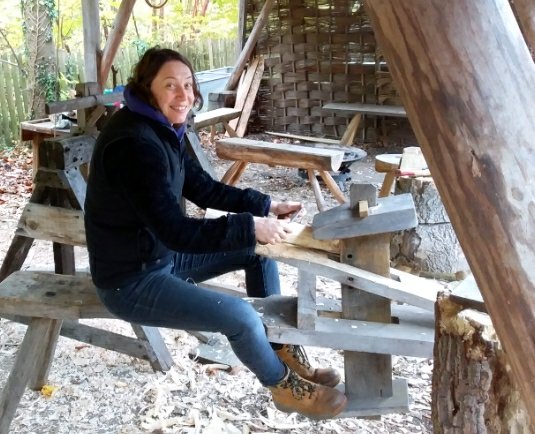
Yesterday I had the honour of working with Small Woods Heritage Craft Officer, Neill Mapes. Neill was running the fantastic Build A Bench workshop with a group of local people. The group were already well ahead of me with their welsh stick chairs so I decided to make a start on a milking stool instead. This will be my first chair and I’m very excited about it.
The first job was to cleave some ash into leg sized pieces. Next an axe was used to pare down the legs into a leggy shape, and prepare the end to be more or less the same size as a 1 inch tenon cutter. The legs were shaped further on the shaving horse with a draw knife.
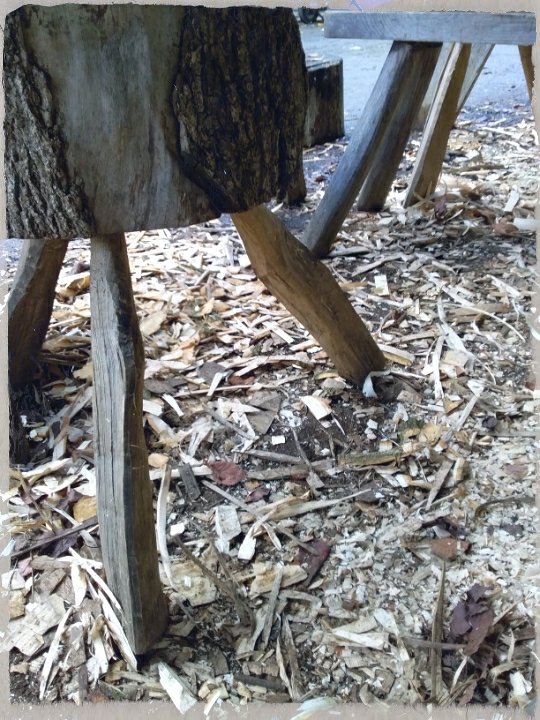
To attach the legs to the chair I will be using green wood working. This means that I will dry the legs by a radiator for a few days then attach them to a ‘green’ seat. As the unseasoned green seat drys it will shrink around the legs, meaning that, apart from a few wedges, there will be no need for screws or nails. Ingenious!
I cut the seat out on a bandsaw and its ready to go once the legs have dried.
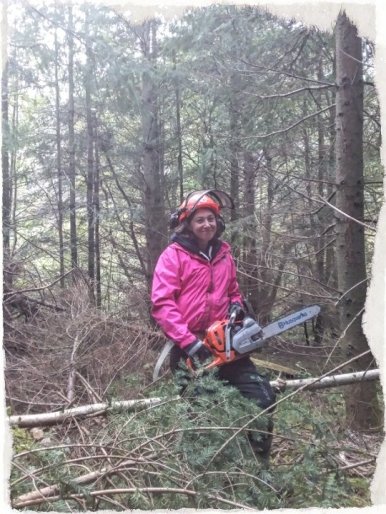
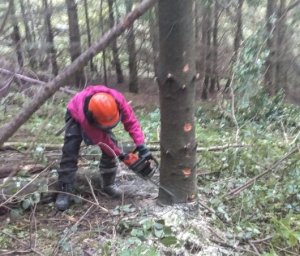
As most of my friends will tell you, I am a raging hippy at heart and one of the conflicts I have about being a coppicer is the idea of cutting down trees. So this week the internal conflict has been at full volume as I’ve been learning how to use a chainsaw.
As someone who grew up in a city and only experienced woodlands as a ‘consumer of
Sharpening the chain
the woodland experience’ I had no idea how much management, and cutting, occurs in a woodland. The thing that I am beginning to realise is that woodland ‘management’ from humans and our ancestors has been going on for so long that the very ecosystem has evolved around human activity. It expects us to clear small parts of the forests periodically so that certain flowers will grow. It expects us to burn things and thin areas out. We protect it from diseases and invasive species, yes so that we can get materials for ourselves, but this is a symbiotic relationship. The relationship has only changed extremely recently to a parasitic one since we’ve been turning wood into money instead of just useful products and materials.
With that said, chainsaws still feel a little too imposing. But at the end of the day they are a great tool to have if you ever need to cut a tree down or cross cut logs.
During this week we’ve learnt all the basics of chainsaw maintenance, felling cuts and all the health and safety stuff that goes with cutting huge bloody trees down. One of the common issues with cutting down conifers in plantation woodland is getting a ‘hung’ tree. A hung tree is a tree that you’ve cut but has been caught up in the nearby trees instead of falling to the ground. This happened on most of my cuts and there are several ways you can deal with it.
One of the ways is to lightly ‘feather’ away the ‘hinge’ with the chainsaw. I know. ‘Feather’ and ‘Chainsaw’ don’t really seem to match but in some circumstances, plunging straight in with the chainsaw will pinch the saw between the tree and the stump, so when one ‘feathers’ with a chainsaw you are lightly brushing the wood with the saw so that it doesn’t get trapped. When you feather away a hinge you leave about 20% of the hinge attached. The hinge is extremely important as it gives the feller a certain amount of control and predictability over where the tree will fall. If you take the whole hinge off too early it can topple in an unexpected direction.
Once you have a peg you can then use a pole or a felling bar with a hook to lever the tree to one side. This, however, doesn’t always work. When you’ve tried every other option thats safe to use – surfing on top of it is a no no unfortunately – then its time to get the winch out as we did today.
I’m happy to say that I won’t be cutting too many trees down, unless they are well chosen standards to bring more light into a coppice. However, using chainsaws for coppicing is another thing all together and I look forward to seeing how that all works in the near future.
That’s right. A log can accurately predict the likelihood of you swearing under your breath when it refuses to split.
A beeping beep
Trying to split a 50 – 60cm diameter piece of tree can be quite a challenge. Especially if it was a gnarly bit, a point where the tree split or is still too damp and keeps absorbing the maul. The first three or four foot of the tree are also notoriously tougher. So sometimes its not just a case of whacking it as hard as you can – although that helps – but just like in palmistry you need to learn how to read a log.
Every single part of the tree is different and so each new round piece is a different challenge. My mentor Mark suggested going for the heartwood first and getting a split in that. Then it seemed that heading for the edges helped the split to shoot through the log.
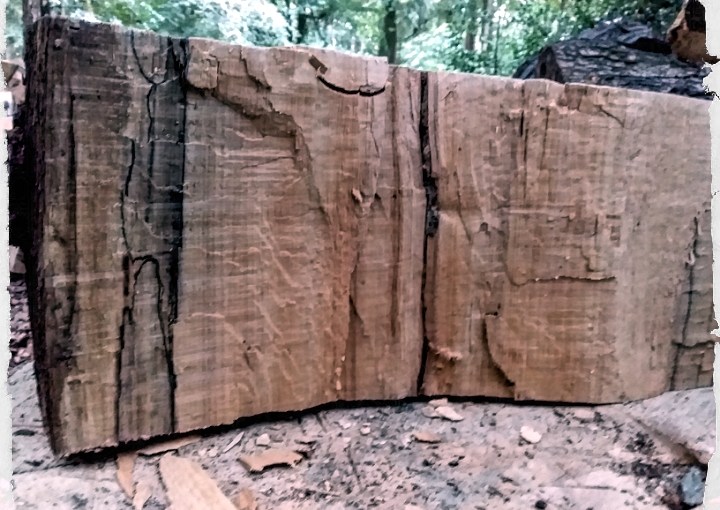
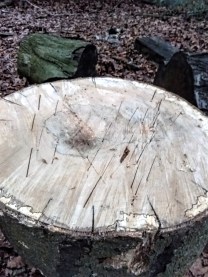
But when the basics don’t work you need to have a closer look at the details of the particular piece of round wood in front of you. For example, each piece of trunk has a small crack in it’s centre. Logically you might think, like I did, that if I followed that crack it was be an easy task. But actually what I found was that it split better if I went perpendicular to that natural crack. The cracks around the side of the ring are not always useful either. Some times they can indicate a point of weakness but, as Mark put it, sometimes they are irrelevant.
A friendlier bit of tree trunk
The main thing to look out for is signs of branches. These bits are going to be very knotty and its best to chip around them rather than attempting to hack them into smaller pieces.
Turning a piece of trunk upside down can also help. Sometimes one side is more forgiving than another. When you’ve got a really big piece then it might be a case of chipping off one side then going around the ring as if you’re slicing up a cake. Once you’ve split the piece of trunk in half you can have a really good look at the way the tree has grown and chose the spot where the rings are straightest and will easily split in half.
There’s nothing quite like hearing that certain cracking noise to predict a little internal fist pump after you’ve spent five minutes trying to split a bit of tree trunk.
“Before enlightenment, chop wood, carry water. After enlightenment, chop wood, carry water.”
Zen Proverb
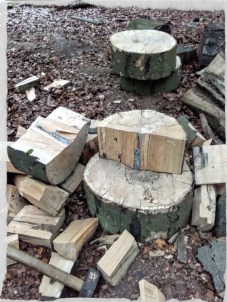
Today in Coppice Land I have spent a lovely day in the woods chopping wood. Firewood is a good income for coppicers and my Mentor, Mark, was lucky enough to know someone with a group of dead beech trees that needed taking down. Mark has kindly obliged and now has a stack of logs to send of to a local garden centre.
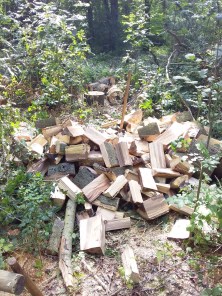
pile of logs
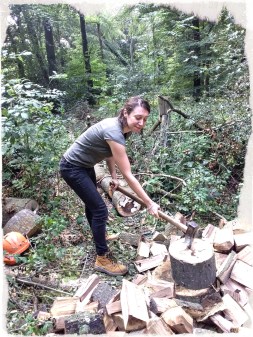
The key thing I found when splitting logs, or also sometimes called cleaving, is that you need to use your legs. Unfortunately I didn’t actually do this – and after four hours of log splitting my back is killing me! Its a classic mistake to use your back when doing any strenuous work but next time I’ll be using my legs more – even if it means I have to stand in a funny crouching position all day. Its worth it!
Otherwise it was a very satisfying job. Perhaps, I mused while I chopped, it’s because this job is probably written into my very DNA. For thousands of years we’ve been doing this kind of work and my body seemed to have a natural intuitive reflex towards the task… although thinking a bit more about it, and feeling how my back feels, perhaps not. But I have to say, there is something romantic and wholesome about splitting logs.
The most zen moment of the whole day was when I realised that the splitting became easier when I stopped trying to do the work, meaning, when I let the maul (the heavy
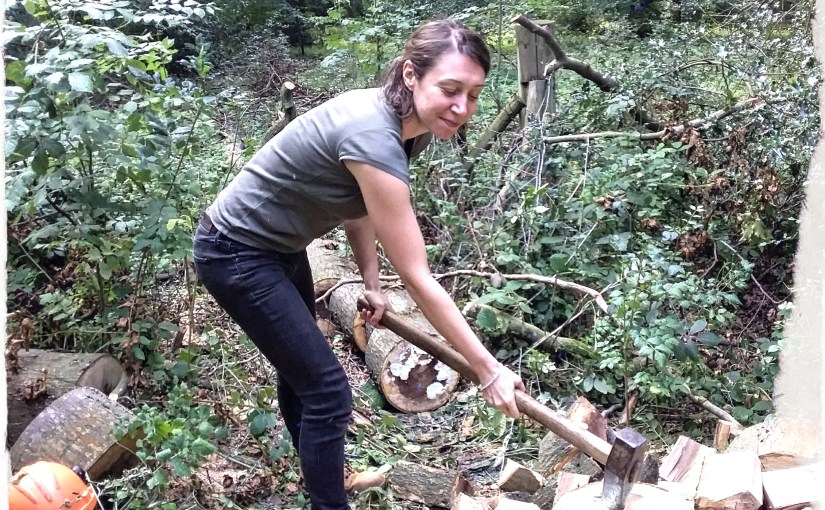
how NOT to hold a maul if you want to split a log – unless you’re posing for a picture
axe) do the work for me and I let the axe fall, using its natural weight, the logs would happily ping apart, and my wrists wouldn’t hurt so much. Just like in the Taoist tradition, one needs to let go of trying and just allow things to be as they are, and allowing a maul to do its job with minimal input from me was very enlightening indeed.
UPDATE: After another day of swinging a maul I released that I was doing some of the work and in fact the process was one of co-creation rather than surrender, a more Yin and Yang relationship rather than channelling pure tao. (Can you tell I had a lot of time to think about this. But what a wonderful way to spend a day – pondering the taoism of chopping wood!)