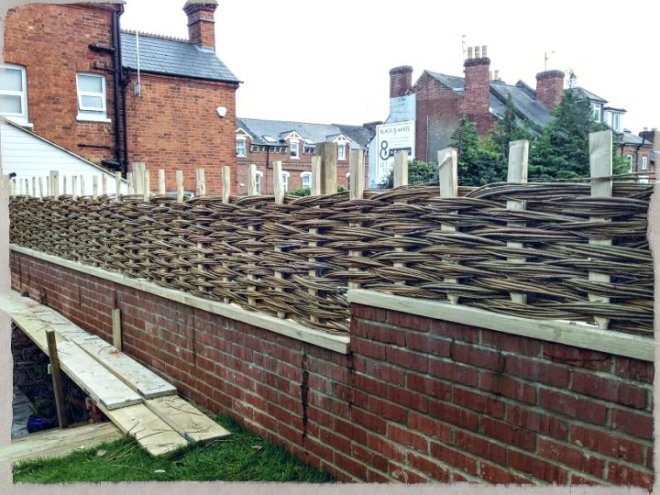
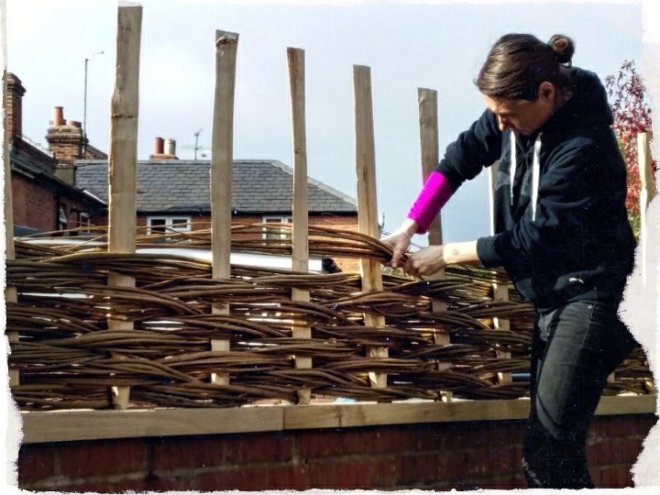
Today I had a chance to work on a willow in-situ hurdle. The fence was about 10mtrs long topping a small brick wall. My new mentor, Dave Jackson, started the fence by drilling oak beams to the top of the brick wall as supports for the sweet chestnut uprights. We then weaved in wet and dry willow rods that were cut about one year ago.
This was an easy enough job with a beautiful finish. This is going to be a wonderful skill to have.
Top tips for the day:
Keep the butts of the rods that you add to the hurdle as close to the uprights as possible. This will reduce the amount of pruning at the end of the job.
Use thicker rods to correct any uprights that are being pushed out of alignment. The stronger rods will push the uprights back but be careful not to push them back yourself too much as they can snap.
Mix the sizes of rods you use in each handful so that all the different sized rods get used and there is a good variety of sizes across the hurdle.
“Before enlightenment, chop wood, carry water. After enlightenment, chop wood, carry water.”
Zen Proverb
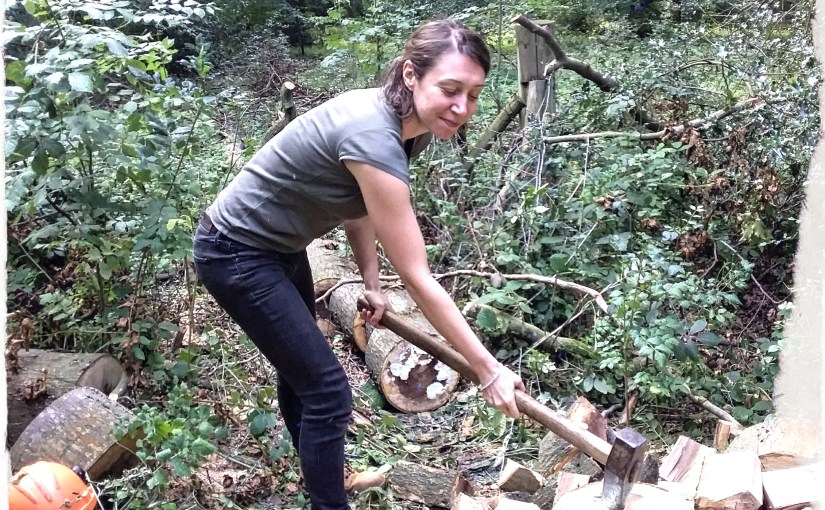
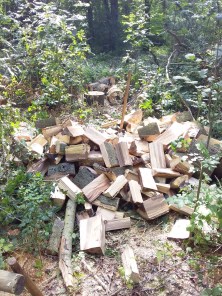
Today in Coppice Land I have spent a lovely day in the woods chopping wood. Firewood is a good income for coppicers and my Mentor, Mark, was lucky enough to know someone with a group of dead beech trees that needed taking down. Mark has kindly obliged and now has a stack of logs to send of to a local garden centre.
pile of logs
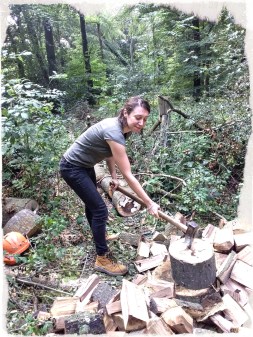
The key thing I found when splitting logs, or also sometimes called cleaving, is that you need to use your legs. Unfortunately I didn’t actually do this – and after four hours of log splitting my back is killing me! Its a classic mistake to use your back when doing any strenuous work but next time I’ll be using my legs more – even if it means I have to stand in a funny crouching position all day. Its worth it!
Otherwise it was a very satisfying job. Perhaps, I mused while I chopped, it’s because this job is probably written into my very DNA. For thousands of years we’ve been doing this kind of work and my body seemed to have a natural intuitive reflex towards the task… although thinking a bit more about it, and feeling how my back feels, perhaps not. But I have to say, there is something romantic and wholesome about splitting logs.
The most zen moment of the whole day was when I realised that the splitting became easier when I stopped trying to do the work, meaning, when I let the maul (the heavy
how NOT to hold a maul if you want to split a log – unless you’re posing for a picture
axe) do the work for me and I let the axe fall, using its natural weight, the logs would happily ping apart, and my wrists wouldn’t hurt so much. Just like in the Taoist tradition, one needs to let go of trying and just allow things to be as they are, and allowing a maul to do its job with minimal input from me was very enlightening indeed.
UPDATE: After another day of swinging a maul I released that I was doing some of the work and in fact the process was one of co-creation rather than surrender, a more Yin and Yang relationship rather than channelling pure tao. (Can you tell I had a lot of time to think about this. But what a wonderful way to spend a day – pondering the taoism of chopping wood!)
One of the many things I’m looking forward to during my apprenticeship is meeting the various local coppicing communities. Coppicers tend to work alone as sole traders and this means that networks are an important way for local coppicers to meet and share skills and stories.
This weekend I had the honour of being invited along to one of the East Anglian Coppice Network events being held at a woodland owned by Iain Loasby. I met Iain after discovering his shop just up the road from me in London. When I came across his shop a year ago I was intrigued by this strange shop that seems to being selling a variety of sticks. When I won the national coppicing apprenticeship I was delighted to remember this shop and realised what a treasure was on my door stop. Although the name would suggest otherwise, Wood Green was the last place I’d expect to find a coppicers shop.
So a few weeks ago I eagerly presented myself to Iain as a fledgling coppicer and was invited along to the network event.
On the agenda this time around was Besoms Brooms and Traditional Rakes. Both of these, especially brooms, are a staple for coppicers and although not used as much for their originally purpose still attract customers looking for a nice item on their wall.
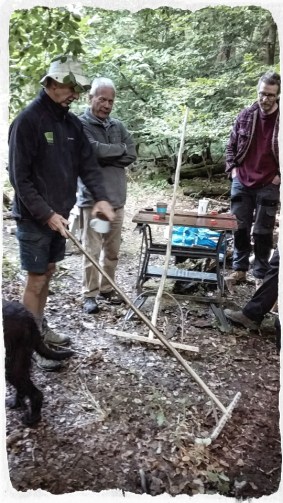
Andy and Paul showing us different types of rakes
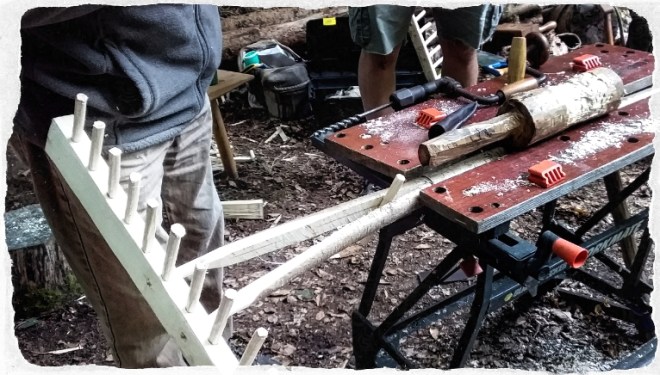
First up was Paul, a newly retired coppicer, who showed us how to make an ash rake. Rakes often come with regional differences and can use a split handle or a flexible piece of hazel to brace the head. I believe in this case we were being taught the Suffolk way of putting a rake together.
Before anything else you need a nice piece of ash around 6 – 10cm in
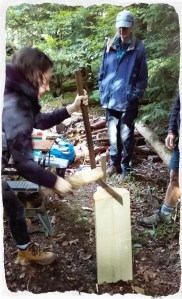
splitting the Ash log
diameter to make heads. We were lucky enough to have a lovely piece of ash that split beautifully and I was assured it wasn’t always this easy.
Once you have a rough size its time to use a shave horse to take the bark off and turn it into a lovely smooth piece of wood. Paul chose to ‘batter’ his heads which is a bricklaying term that means making the top of the head thinner than the bottom, but Andy, another coppicer at the event didn’t think this was necessary.
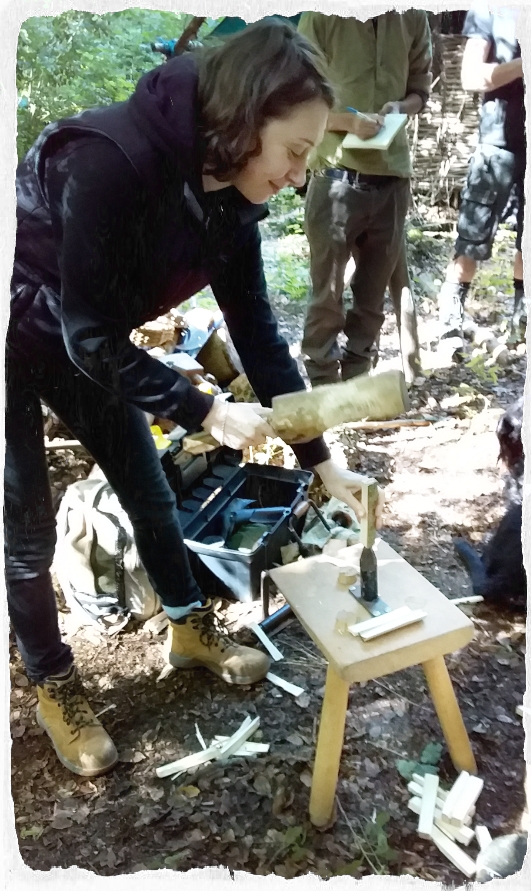
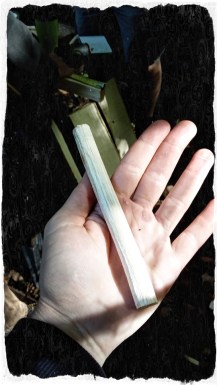
Making the pegs was an interesting process. First a piece of tree truck the same length as you want your pegs was split into tiny pieces, using an old inner tube to hold the wood together, then these pieces were jammed through a piece of metalwork called a tine cutter. Apparently its useful to have a splayed end on your tine cutter so that the tines don’t get stuck as they push through the hole.
One of the great things about the day was getting these sorts of little hints and tips from the experienced coppicers. “Throw the mallet instead of hit it” was advice from Andy which stopped my wrist hurting so much, and “aim for down here” was more great advice from Paul as he pointed to half way down the piece of wood I was preparing to split with a Froe (a type of wood splitting tool).
After the tines/pegs were made the next task was to drill holes into the head. Paul suggested using a ‘green’ head (a piece of wood that hasn’t been seasoned) with seasoned pegs. This would mean that the head would season and shrink around the pegs, holding them into place.
The pegs were then shaved down on two sides and bashed in with a mallet. Next we needed to choose a handle and split the end. A rake handle can be quite long and needs to be straight as possible but can have some wiggles* in it for character. After the handle and head are fixed together copper nails were used to keep the head and handle together.
joining the head and the handle together
Another handy tip to remember was to drill a hole at the end of the split and wrap some wire around to keep the split from going any further.
Besom Brooms
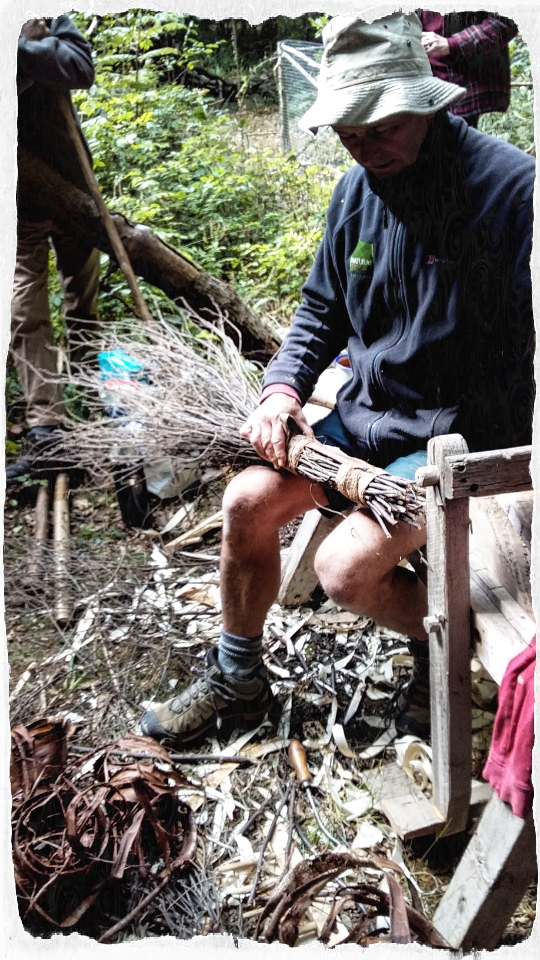
Andy showing us how to bind birch sprays with elm bark
In the afternoon it was Andy Bashem‘s turn to show us how to make a good broom. I’ve already helped my mentor Mark to collect birch ‘sprays’ (birch sticks) so it was interesting to see the next step in the process.
Andy chooses to make all natural brooms without any metal parts as this seems to appeal
more to witches. No, this isn’t a joke. Apparently wiccans use besom brooms to clear old spells from ritual spaces but the brooms mustn’t contain any metal. This is the kind of vital information passed on during networking events. There is also an aesthetic reason for a wireless broom but it does take much more time to make.
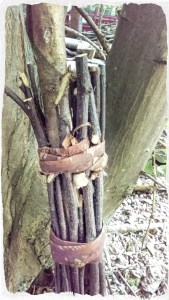
One starts off by grabbing a handful of birch sprays then moving them around until all the bottoms of the twigs are lined up. You need a bit space to wrap around your binding material so any twigs that are in the way are pruned. When your happy with your bundle of birch sprays you can then start the wrapping process. In this case we used some Elm Bark that Andy had had in his barn for a couple of years. To refresh it he simply soaked it in water for a couple of hours the night before and the bark became flexible again like leather.
Once the binding was on tight we then drove a sharpened stake through the middle of the bundle and used a wooden peg to hold the handle in place. The peg is important to stop the twigs and the handle from separating and the customer being left with a very sharp stick in their hands. A good handle can also increase the price of a broom if it has special features like twists. Andy didn’t try to make the broom look all the same and believed that as people are all unique then the difference in the brooms would appeal to different people. As I didn’t pick up enough birch I was pleased to hear this and declared my very small broom a special camper van sized broom to fit into tiny houses just like my own. The broom was then bound with baling twine so that when the twine was removed in a few days the broom would maintain a slimmer shape.
Overall I had a lovely day with the East Anglian Coppice network. I raked in the knowledge and wasn’t swept away by all the new information at all.
I hope to visit some of the members coppices over the next few years and plan to join them at another event soon!
*I’ll develop my technical terminology as go – but in the mean time i’ll be making up my own…)
“The tree which moves some to tears of joy is in the eyes of others only a green thing that stands in the way. Some see nature all ridicule and deformity… and some scarce see nature at all. But to the eyes of the man of imagination, nature is imagination itself.”
– William Blake
“A sure cure for seasickness is to sit under a tree.”
– Spike Milligan
Hello! My name is Suz and I am a coppicer. Well… not quite yet. But I was lucky enough to be chosen to be part of the National Coppice Apprenticeship Scheme, which is a partnership between Small Woods and the Bill Hogarth MBE Memorial Apprenticeship Trust and funded by The Ernest Cook Trust – you can read more about that here.
This blog is a diary of my journey from London based care worker to fully fledged woman of the woods. It will document the lifestyle of a modern day coppicer and all the techniques and tools that are involved. This is such a great sustainable industry so it’s an honour to be part of the resurgence of the coppicing community. I hope you enjoy this journey with me!
Suz x
P.S. Please feel free to correct me on any errors I’ve made in the comment sections below the offending post. This is a learning diary and any corrections will be greatly appreciated and will hopefully help others as well.
P.P.S. Please subscribe and pass on to anyone who you think will find this interesting. Cheers!

 Today I had a chance to work on a willow in-situ hurdle. The fence was about 10mtrs long topping a small brick wall. My new mentor, Dave Jackson, started the fence by drilling oak beams to the top of the brick wall as supports for the sweet chestnut uprights. We then weaved in wet and dry willow rods that were cut about one year ago.