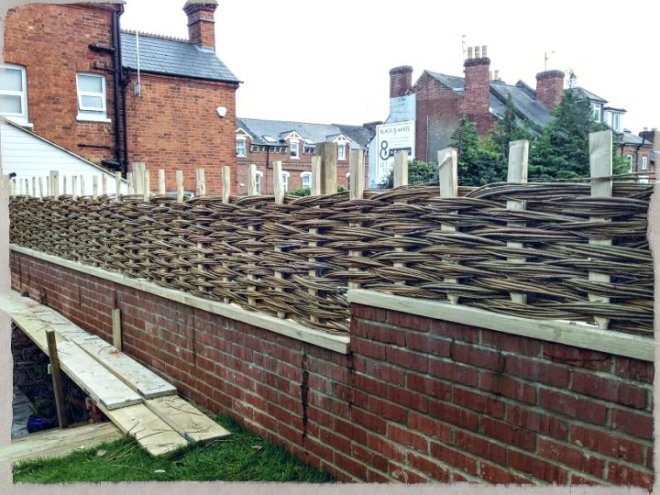
Today I had a chance to work on a willow in-situ hurdle. The fence was about 10mtrs long topping a small brick wall. My new mentor, Dave Jackson, started the fence by drilling oak beams to the top of the brick wall as supports for the sweet chestnut uprights. We then weaved in wet and dry willow rods that were cut about one year ago.
This was an easy enough job with a beautiful finish. This is going to be a wonderful skill to have.
Top tips for the day:
Keep the butts of the rods that you add to the hurdle as close to the uprights as possible. This will reduce the amount of pruning at the end of the job.
Use thicker rods to correct any uprights that are being pushed out of alignment. The stronger rods will push the uprights back but be careful not to push them back yourself too much as they can snap.
Mix the sizes of rods you use in each handful so that all the different sized rods get used and there is a good variety of sizes across the hurdle.
One of the hard questions in coppicing is what to do with all the bits of hazel on a stool (that’s what the trunk that the new shoots grow from is called) that have grown all bendy.
Bendy rods (aka branches) can occur for a few reasons. It may be due to ‘browsing’ from wildlife such as deer. Muntjac deer are very common in the woods where we work and are a pain for coppicers. There are various ways that people use to stop the deer but the most effective it seems is building a huge blummin’ fence. My mentor and myself did speculate whether a stuffed lion or two might work well instead after I mentioned that my father used to be a taxidermist. If we try this I’ll let you know how it goes.
Another reason for bendy rods can be a lack of light. If the shoots have to compete for light with the standard trees (the trees that are left to grow to full size) then they’ll contort their way towards the light that is available. This can also slow growth which can lead to more twisty turny bits. A coppice works best without standards as the coppiced trees get the maximum amount of light but sometimes space is a premium and standards can provide firewood and also a more varied environment for wildlife. When standards are used/left they should only take up 40% of the canopy cover, leaving 60% of the sky still visible.
Anyway, I’ve digressed… Let’s talk about crafts!
Coppicers come up with many ingenious ideas for what to do with all the little bits of wood. Products such as whistles or pencils are popular as well as gypsy flowers and even little christmas decorations.
Over the last few months as I’ve been preparing for the apprenticeship I have also been wondering what I could make with all those little bits. I decided that, however bendy a rod, you can always make disks and a disk is a very useful shape indeed.
My inventions so far have included ‘tree hanging’, bracelets and bowels, all made partly from discs or small bits of sticks. I’m keen to use as much of the stuff we cut down – apart from whatever would be beneficial as habitat homes – and find as many uses as we can. My mentor is also keen on this practice. After drilling holes in some candle holders we decided that the shaving were too good to throw and thought about how they could be used (we decided perhaps some kind of delicate flower decoration).
The level of creativity in this is endless when your base material is the humble stick!

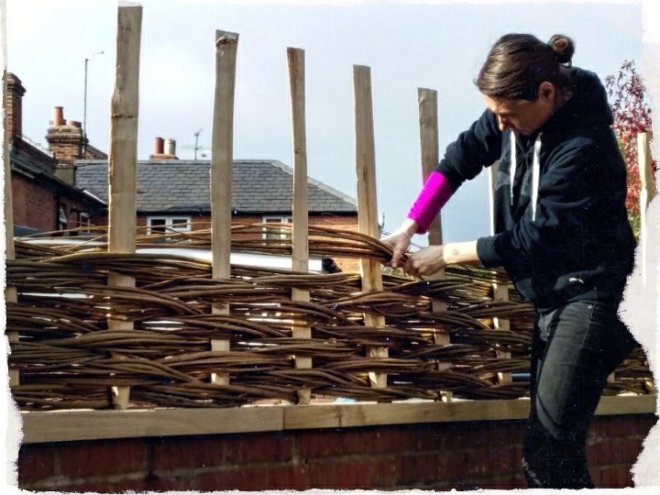 Today I had a chance to work on a willow in-situ hurdle. The fence was about 10mtrs long topping a small brick wall. My new mentor, Dave Jackson, started the fence by drilling oak beams to the top of the brick wall as supports for the sweet chestnut uprights. We then weaved in wet and dry willow rods that were cut about one year ago.
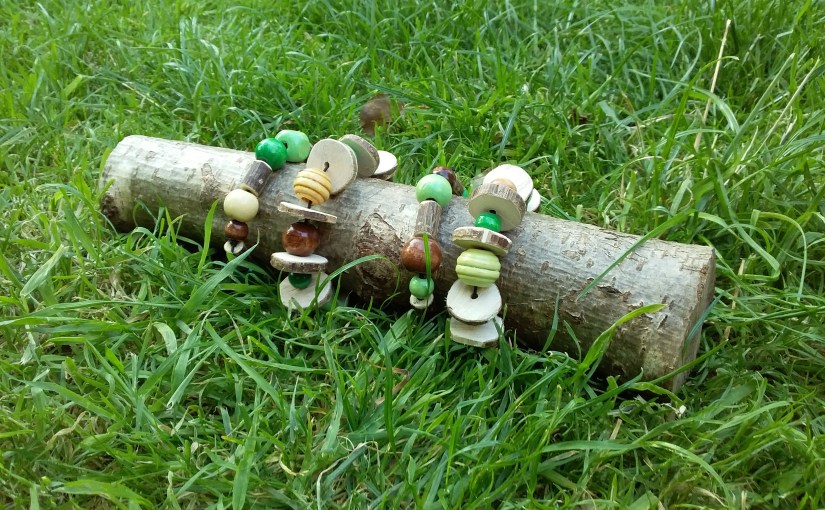


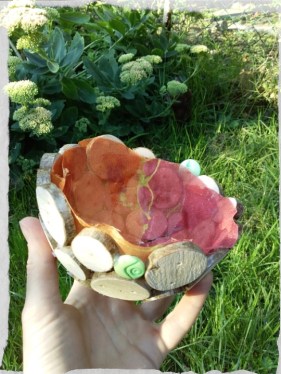 e also been wondering what I could make with all those little bits. I decided that, however bendy a rod, you can always make disks and a disk is a very useful shape indeed.

